The Spring Slog: Protecting Your Undercarriage in Morrow County’s Muddy Fields
Undercarriage Maintenance

Spring in Morrow County is a season of opportunity and frustration rolled into one. For dryland wheat farmers around Lexington and Heppner, it signals critical fieldwork windows. For excavation contractors working along I-84 corridors or rural access roads, it means projects ramp up fast. But it also means mud. Thick, heavy, Eastern Oregon mud that clings to tracks, packs into rollers, and adds strain to every moving component under your machine.

At Bailey Heavy Equipment Repair, we see the aftermath every year. Machines that made it through winter without issue suddenly show accelerated wear. Undercarriages take the brunt of it. If you are running dozers, track loaders, or excavators in saturated ground, protecting your undercarriage is not optional. It is the difference between staying productive and scheduling costly downtime for heavy equipment repair in Lexington, OR.

Why Spring Mud Is So Hard on Undercarriages

Morrow County soil has a personality. When it is dry, it is dusty and abrasive. When it is wet, it becomes dense and adhesive. That combination creates ideal conditions for undercarriage stress.

As mud builds up inside the track system, it increases weight and resistance. Tracks have to work harder to rotate. Rollers and idlers are forced to push against packed debris. Sprockets grind through mud that often contains fine gravel and grit, accelerating wear.

For dryland wheat operations, this is especially common during early spring passes when fields are workable but still holding moisture. Excavation crews digging foundations or trenching utilities near Boardman or Irrigon deal with similar conditions. Over time, that constant strain leads to worn components, uneven track wear, and premature sprocket and roller replacement.

Routine Morrow County equipment maintenance becomes even more critical during this time of year.

The Importance of Regular Undercarriage Inspection

The undercarriage can account for a significant percentage of total machine wear costs. Yet it is often overlooked until performance noticeably declines. A proactive undercarriage inspection in spring can save thousands in long-term repair expenses.

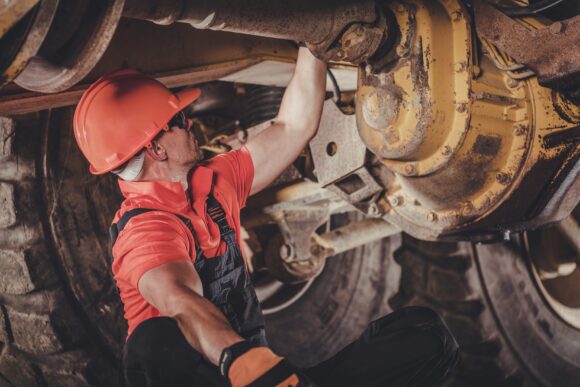
Start by checking for excessive mud buildup after each day of operation. Inspect track pads, rollers, idlers, and sprockets for uneven wear patterns. Look for cracked or loose hardware. Pay attention to unusual noises or vibration during operation, as these can signal misalignment or excessive tension.

For operators in Lexington and throughout Morrow County, scheduling a professional undercarriage inspection early in the season allows issues to be identified before they escalate. Our team at Bailey Heavy Equipment Repair frequently provides heavy equipment repair in Lexington, OR that could have been minimized with earlier detection.

The key is not waiting until track failure or visible damage forces a shutdown.

Track Tension Adjustment: A Small Fix With Big Impact

One of the most common springtime issues we see is improper track tension. Mud buildup can alter tension temporarily, masking underlying problems. Once the mud dries and falls away, tracks may become too loose or too tight.

Track tension adjustment is not just about comfort. It directly affects wear rates. Over-tightened tracks increase stress on rollers, idlers, and sprockets. Loose tracks risk derailing and cause uneven wear on bushings and pins.

In Eastern Oregon’s fluctuating spring temperatures, tension settings may need more frequent monitoring. Machines that move from muddy fields to firmer ground require adjustments to maintain optimal performance.

Our Eastern Oregon diesel mechanics often perform track tension adjustment as part of routine Morrow County equipment maintenance. This relatively simple service can extend undercarriage life and reduce the need for premature sprocket and roller replacement.

Heavy Machinery Cleaning Is Not Just About Appearance

After a long day in saturated soil, it is tempting to park the machine and move on. But heavy machinery cleaning is one of the most effective ways to protect your undercarriage during spring.

Mud that remains packed inside track frames hardens as it dries. That hardened material restricts component movement and traps moisture against metal surfaces. Over time, this accelerates corrosion and wear.

Regular cleaning reduces excess weight and allows you to spot developing problems more easily. Pressure washing undercarriages may seem like an added chore, but it pays off in extended component life.

For contractors and farmers balancing tight schedules, field service for heavy machinery can help streamline this process. Our mobile technicians often assist with inspections and adjustments directly on-site, minimizing downtime.

Knowing When Replacement Is Necessary

Despite best efforts, some wear is inevitable. Spring conditions may reveal components that were already nearing the end of their lifespan. Recognizing when sprocket and roller replacement is necessary prevents catastrophic failures during peak work windows.

Worn sprockets often show hooked or pointed teeth. Rollers may exhibit uneven wear or leakage. Idlers can develop excessive play. Ignoring these signs risks damage to adjacent components, multiplying repair costs.

For dryland wheat farmers facing narrow planting or spraying windows, unexpected breakdowns can disrupt critical timelines. Excavation contractors working on scheduled projects face similar risks. Proactive Lexington farm equipment repair ensures that minor issues do not snowball into major interruptions.

Our team provides heavy equipment repair in Lexington, OR tailored specifically to the demands of Morrow County operations. We understand that downtime in spring carries a higher cost than at almost any other time of year.

The Value of Local Expertise in Eastern Oregon

Operating heavy machinery in Eastern Oregon requires understanding local conditions. Soil composition, seasonal moisture patterns, and temperature swings all influence equipment wear.

Our Eastern Oregon diesel mechanics are familiar with the realities of working in Morrow County’s fields and job sites. We know how spring mud affects track systems. We know which components tend to fail first under these conditions. And we know how to prioritize repairs to get you back to work quickly.

Field service for heavy machinery is especially valuable in rural areas where transporting large equipment can be time-consuming and expensive. By bringing inspection and repair services directly to your location, we help reduce logistical challenges and keep operations moving.

Building a Spring Maintenance Routine

Protecting your undercarriage during the spring slog does not require overhauling your entire maintenance plan. It requires consistency.

Schedule routine undercarriage inspection intervals during peak muddy periods. Monitor track tension adjustment more frequently than in dry seasons. Prioritize heavy machinery cleaning to prevent hardened debris from accumulating. Address early signs of sprocket and roller replacement before failure occurs.

By integrating these practices into your standard Morrow County equipment maintenance routine, you reduce long-term costs and extend machine life.

Spring in Lexington and across Morrow County will always bring mud. It is part of farming and construction in this region. But with proactive maintenance and experienced support, it does not have to bring unexpected downtime.

At Bailey Heavy Equipment Repair, we are committed to supporting dryland wheat farmers and excavation contractors through every season. From heavy equipment repair in Lexington, OR to field service for heavy machinery throughout Eastern Oregon, our goal is simple. Keep your machines running strong, even when the fields are at their toughest.
The Spring “Wake-Up”: Ensuring Your Fleet is 100% Mission-Ready

Spring arrives fast in Lexington, OR, and for farmers, utility crews, and equipment managers across the region, it brings one unavoidable truth: the machines that sat idle through the winter months need to be ready to work the moment the ground thaws and the season demands full output. There is no room for a tractor that stalls mid-row, a utility truck that fails dielectric testing, or a hydraulic cylinder that leaks under pressure when the planting window is open and every hour counts. The cost of preventable downtime during peak season is not just mechanical; it hits your bottom line hard and can push an entire operation weeks behind schedule. That is why a comprehensive spring equipment inspection and service plan is not optional. It is the foundation of a productive, profitable season.

Whether you manage a sprawling agricultural fleet, a utility maintenance crew, or a construction operation, the principles of spring readiness apply universally. Getting ahead of failures before they happen is always less expensive than reacting to them in the field. This guide walks through the most critical service areas to address before the season kicks into high gear.

Why Spring Servicing Is the Smartest Investment You Can Make

The logic behind spring agricultural equipment repair is straightforward: machines that sit through cold, wet winters accumulate problems that are invisible until stress is applied. Seals dry out and crack. Hydraulic fluid absorbs moisture and degrades. Metal surfaces experience minor corrosion that worsens under load. Hoses that looked fine in October can fail in April when pressure cycles begin again.

Preventing spring downtime is not about being overly cautious. It is about understanding how equipment ages and responding with targeted service before those aging components become operational emergencies. Shops serving the Lexington, OR area see a predictable surge in emergency repair calls every spring, and nearly all of them trace back to deferred maintenance that could have been caught weeks earlier during a thorough inspection. Scheduling your equipment for a full evaluation before the season is one of the highest-return decisions you can make as an equipment manager or fleet owner.

The financial case is equally strong. A proactive hydraulic system service visit costs a fraction of what you spend on an emergency repair, lost productivity, and the logistical chaos of pulling a machine out of rotation during peak demand. Extending machinery lifespan through consistent, seasonal maintenance also means you get more years out of capital investments, reducing your long-term equipment acquisition costs significantly.

Hydraulic System Service: The Heart of Your Equipment’s Performance

Hydraulic systems are the circulatory system of modern agricultural and utility machinery. They power lifts, steering, attachments, and dozens of other critical functions. When hydraulic components fail, the entire machine is typically sidelined. Spring is the ideal time to conduct a complete hydraulic system service because you have the opportunity to identify issues in a controlled environment rather than discovering them in the middle of a job.

A proper hydraulic service includes fluid analysis and replacement, filter servicing, and a thorough inspection of all components for leaks, wear, and pressure inconsistencies. Hydraulic hose assembly is one of the most frequently overlooked aspects of this process. Hoses are subject to UV degradation, abrasion, and pressure fatigue over time, and a hose that fails in the field can cause not just downtime but also environmental contamination and safety risks. Replacing aging or suspect hoses as part of a spring service package is a straightforward way to eliminate one of the most common causes of mid-season failures.

Cylinder repair and honing is another essential element of a complete hydraulic service. Over time, cylinder bores develop scoring, corrosion, and dimensional wear that compromise seal performance and reduce efficiency. Honing restores the bore surface to proper specifications, allowing new seals to seat correctly and the cylinder to operate with full power and precision. If your cylinders have been showing signs of drift, sluggishness, or external leakage, spring is the time to have them professionally inspected and reconditioned before they create a larger problem.

Precision Line Boring: Restoring Structural Integrity Where It Matters Most

Heavy equipment takes tremendous punishment in agricultural and utility applications. Pivot points, pins, and bores wear over time from the constant cycling of load and movement. When these wear points are ignored, the resulting slop and misalignment accelerates wear on surrounding components and reduces the machine’s overall structural precision.

Precision line boring is the professional solution for restoring worn bores to their correct dimensions and alignment. This process uses specialized tooling to machine a bore in place, ensuring that the centerline is perfectly aligned and the diameter is restored to factory specifications. It is a repair that cannot be replicated with improvised methods, and it makes a significant difference in the long-term health and performance of loader arms, excavator booms, and other high-stress structural assemblies.

For operations in Lexington, OR and surrounding areas, having access to precision line boring capability locally means you do not have to ship major components across the state or take entire machines offline for extended periods. The ability to perform this repair efficiently and accurately is a hallmark of a full-service agricultural equipment repair facility.

Dielectric Testing for Utility Trucks: Keeping Your Crew Safe All Season

Utility fleets face a unique set of spring service requirements, and dielectric testing for utility trucks is at the top of the list. Aerial devices, insulated booms, and other equipment used near energized lines must meet strict safety standards before they are placed back into service. ANSI equipment inspections are not a formality; they are a legal and operational requirement that protects workers and ensures compliance with industry safety regulations.

Dielectric testing involves applying high-voltage electrical stress to insulated components to verify that their insulation integrity meets required standards. Components that pass maintain their rating and can be returned to service with confidence. Those that fail are identified before they create a potentially fatal situation in the field. Scheduling dielectric testing as part of your spring fleet preparation ensures that your utility crews begin the season with equipment that has been verified safe, not just assumed safe.

ANSI equipment inspections go hand in hand with dielectric testing, covering the full mechanical and structural condition of aerial devices and associated equipment. These inspections check for hydraulic integrity, structural soundness, control functionality, and compliance with applicable standards. For fleet managers, having these inspections completed before the busy season means no scrambling to pull equipment for compliance reasons when project demands are at their peak.

Building a Long-Term Fleet Maintenance Strategy Around Spring Readiness

The best equipment managers in the Lexington, OR region do not treat spring servicing as a one-time event. They use it as an anchor point for a year-round maintenance strategy that keeps their fleet in top condition through every season. Extending machinery lifespan is not the result of a single repair; it is the cumulative effect of consistent, quality maintenance over the life of the equipment.

Building a strong relationship with a shop that offers comprehensive services, including hydraulic system service, hydraulic hose assembly, cylinder repair and honing, precision line boring, and dielectric testing for utility trucks, means you have a single, trusted partner for every maintenance and repair need. This consistency builds institutional knowledge about your specific fleet, allowing your service provider to spot trends and address developing issues before they become expensive failures.

Keeping detailed service records, following manufacturer-recommended maintenance intervals, and scheduling preventive service during lower-demand periods are the habits that separate operations with chronic equipment problems from those that run smoothly season after season.

Conclusion

Spring in Lexington, OR is not a time to hope your equipment holds together. It is a time to know it will. A thorough spring service program that addresses hydraulic systems, cylinder condition, structural wear, hose integrity, and safety compliance gives your fleet the foundation it needs to perform at full capacity when the season demands it. Whether your priority is preventing spring downtime, passing ANSI equipment inspections, or simply getting more productive years out of your machinery, the answer starts with a comprehensive spring inspection from a qualified agricultural equipment repair facility. Do not wait for the field to reveal a problem. Address it now, on your schedule, and start the season strong.

Eight Tips on Garbage Truck Maintenance for New Haulers

Are you new to garbage truck maintenance? These vehicles require regular upkeep for optimal operation, and utility vehicle repair poses some challenges that are unique to this type of truck. To keep your vehicles in top shape, use the following tips on garbage truck maintenance.

Develop a preventive maintenance program

Regular servicing is key to garbage truck maintenance. Set up a program that involves regular inspections, servicing and repairs. Determine the frequency of maintenance and stick to this schedule. For example, you may want to schedule general garbage truck maintenance every 150 or 300 miles and more extensive maintenance every 2,500 to 3,000 miles.

Create a preventative maintenance checklist

Your checklist should include a full range of inspections to cover all the systems and prevent the need for future utility vehicle repair. Be sure to include oil changes, filter changes, cooling system inspections, electrical system inspections, tire rotations, exhaust system inspections, lighting checkups, brake system inspections and more. For a complete list of garbage truck maintenance items, contact your local experts who specialize in heavy equipment repair.

Equip drivers for reporting

Drivers must complete daily inspections as part of proper garbage truck maintenance. Provide each driver with an appropriate checklist for this inspection. It should include vehicle safety systems, the truck’s interior and body, as well as other miscellaneous items such as the radio.

Perform body maintenance

The engine and other system components are not the only parts to consider for garbage truck maintenance. Be sure to keep the body in top operating condition as well. These trucks can take a beating during daily use, which puts stress on systems such as forks, rollers, pins and other moving parts of the body. Check for any cracking or other wear in metal components and make appropriate body repairs as soon as possible.

Maintain the hydraulic system

This system is essential for garbage truck performance. Inspect these parts regularly for leaks or other issues. If any problems are noted, take the truck to an experienced mechanic immediately for utility vehicle repair.

Check emissions

Emissions inspections can prevent more extensive utility vehicle repairs. Be proactive about checking emissions systems to avoid future problems. Partner with a trusted mechanic to check the emissions systems regularly.

Maintain brakes and tires

Garbage trucks require frequent stopping, so check brake systems regularly for wear and tear. Inspect tires every day for proper pressure and healthy tread depths.

Keep it clean

Clean trucks regularly, both inside and out. This will prevent debris build-up, which can interfere with truck operation. It will also keep your brand image high and help boost driver morale.

Your local truck experts

Want more tips on garbage truck maintenance? Contact the team at Bailey Heavy Equipment Repair, Inc. We specialize in utility equipment, trucks and other heavy-duty machinery. We offer on-site repair, line boring services, welding, machining, hose assemblies, steel sales and other machine products. Give us a call today with any questions about utility vehicle repair. We look forward to helping you keep your fleet in optimal condition.

The Benefits of Having a Good Relationship with Your Mechanic

It’s always smart to be a savvy shopper, but when it comes to searching for a trusted mechanic to work on your heavy-duty vehicle, you need to have complete trust in the person who’s working under the hood. It’s best to establish a continuing relationship with your mechanic rather than shopping around for the best deal when it comes to vehicle repairs. Here are just a few of the main benefits you can expect when you build a solid relationship with your heavy vehicle mechanic.

Reliable service

One of the key advantages to developing a continuing mechanic relationship is that you’ll have complete confidence in the repair services they provide. Whether you work in the utility, logging or hauling industries, your heavy-duty vehicle is your livelihood, and you can’t trust just anyone to provide the specialized repairs that these rigs require.

Since safe operation of your vehicle is crucial to your own safety as well as to others on the road, it’s not too much of a stretch to say that your mechanic should be someone you trust with your life. By establishing a great working relationship, you’ll be able to trust the quality of every repair, whether minor or major.

Faster repairs

While the speed of repairs varies from shop to shop, having a positive relationship with your mechanic usually helps you get your equipment fixed faster. Taking your heavy equipment to the same shop every time means your mechanic already has a working understanding of your vehicle. They will understand what parts have recently been replaced, as well as how your driving patterns could cause wear and tear on certain components of your vehicle.

Instead of taking your vehicle to a new shop every time and starting from scratch, develop a positive mechanic relationship that allows your service technicians to hit the ground running whenever you bring your vehicle in for repair.

Discounted repairs

It follows that when a service provider can accomplish faster repairs on your heavy-duty vehicle, you’re more likely to see a savings on the overall cost for repairs than you would by visiting a new shop. Since the mechanic will have familiarity with both you and your vehicle, you’re more likely to receive better rates, or “friend prices,” for repairs, although this will ultimately depend on shop policies.

A mechanic who knows your vehicle can also determine what repairs are absolutely essential for your rig versus what qualifies as routine maintenance. Your trusted technician can recommend a beneficial routine maintenance schedule for your vehicle, ensuring you pay for exactly what you need rather than for unnecessary repairs.

While it may be tempting to hunt around for a mechanic who will undercut the competition in terms of the price to repair your vehicle, keep in mind that you always get what you pay for. It’s best to have a great mechanic relationship so you can always trust the person who’s working on your expensive equipment. Contact Bailey Heavy Equipment Repair, Inc. today to discover more of the benefits of developing a positive relationship with your mechanic.

What Is Fleet Maintenance Management and Why Is It Important?

If you have company-owned vehicles, you have a fleet. Whether they’re forklifts, pickup trucks, trailers or company cars, fleet maintenance is crucial in Lexington, OR. Keeping your fleet well-maintained is the key to its longevity. Unfortunately, many companies underestimate the need for regular fleet maintenance—especially the importance of hiring an outside company to do the job.

Keeping your fleet well-maintained ultimately saves a lot of time, money and manpower, especially when you work with a company like Bailey Heavy Equipment Repair, Inc. Read on to find out how fleet maintenance can benefit your company:

When you need fleet maintenance or utility vehicle repair in Lexington, OR, the team at Bailey Heavy Equipment Repair, Inc. can help. Call us today to learn more about our services and schedule your own fleet maintenance management plan. We look forward to working with you!